

Our Story
Cut Caviar was founded with a clear vision: to introduce an old-world delicacy to a new generation — one that sees luxury as a lived experience.
With offices in London and Dubai, we are rethinking how caviar is sourced, served, and savoured. What began as a passion for ocean delicacies, craftsmanship, and contemporary culture has grown into a new kind of caviar house — one that is rooted in heritage, but crafted for how we live now.
Each caviar in our collection is selected for its depth of character and quiet complexity.
But Cut Caviar is not just about quality. It is about shifting perspectives. We believe caviar does not need silver spoons or hushed rooms — it belongs in your everyday.
Our love for caviar has become a mission: to take caviar beyond tradition and into the rhythm of modern lifestyles.
Our Farm
At Cut Caviar, we are committed to quality, sustainability, and refinement.
Our exclusive farm was hand-selected after a global search for aquaculture excellence. Nestled in a remote mountainous region of South-East Asia, it is surrounded by untouched natural beauty and fed by two distinct water systems. One of them — a glacial river — delivers over 1,500 litres of crystal-clear, oxygen-rich meltwater every second, maintaining stable temperatures year-round. This rare, dynamic environment nurtures the sturgeon to full maturity, producing a roe of exceptional structure and flavour.
The result is caviar of extraordinary calibre. Each pearl measures between 2.8 and 3.4 mm, with colour profiles ranging from deep emerald to golden umber, and even rare silvery charcoal. The roe texture is firm yet delicate; the taste is clean and complex — a pure expression of nature, patience, and artistry.
Masters of the Craft
The chefs who work with Cut Caviar share their experience of the product, from its quality and character to the ways they bring it into their own creations.
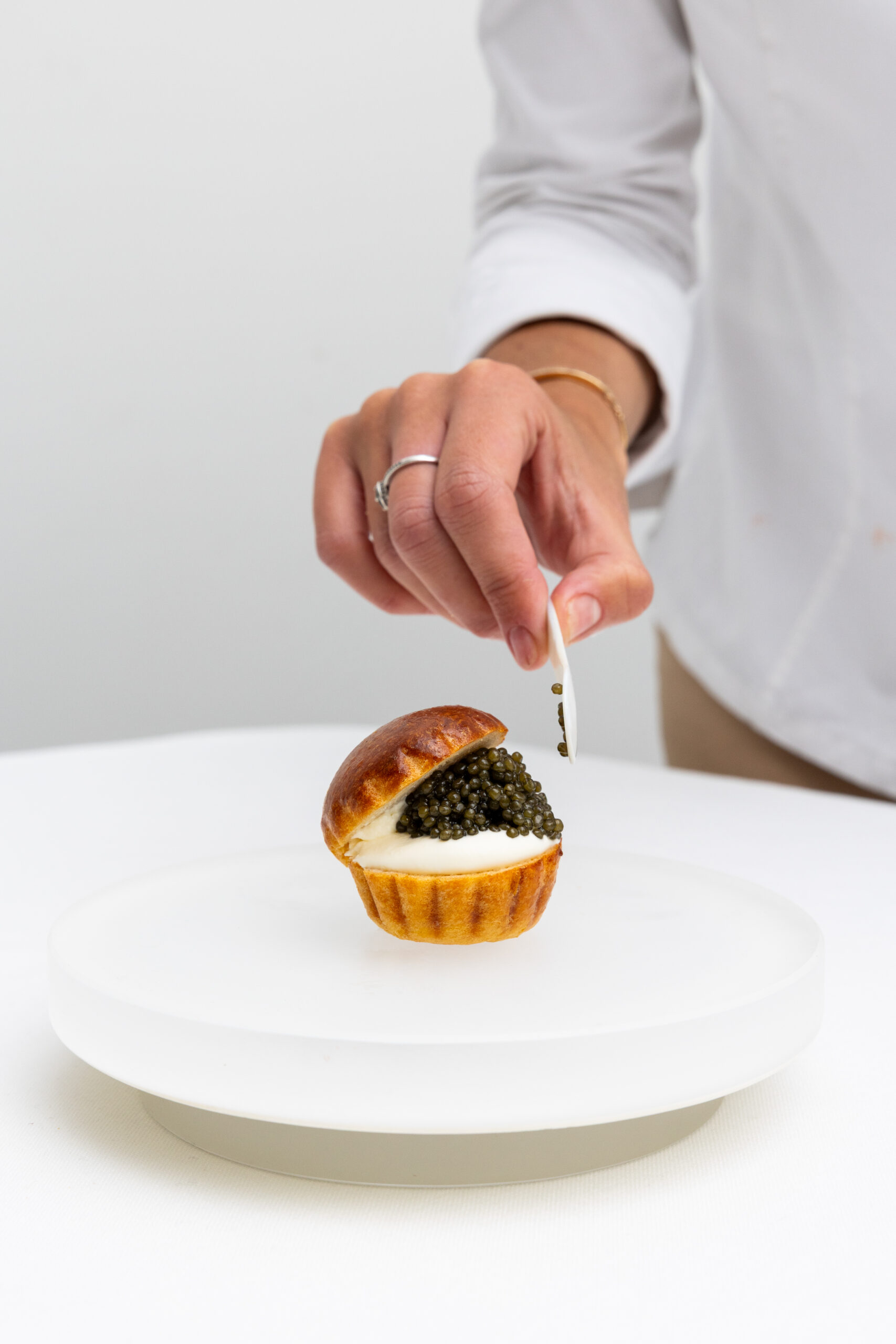
As a private chef trained with Alain Ducasse, I build my menus around a few exceptional ingredients, and Cut Caviar Oscietra is one of them. I serve it on my crab beignets and on soft egg in the shell, for private dinners in London, Paris and beyond. It brings that final touch of luxury my clients look for.
Eugénie Colleville, Private Chef
Sustainability — Thinking in Generations
Sustainability in caviar begins long before a tin is ever opened.
Sturgeon are among the slowest-maturing fish in aquaculture, with each species following its own biological timeline. Some reach maturity within several years, while others take well over a decade.
Responsible caviar farming therefore cannot simply think about the next harvest. It must think years, sometimes decades, ahead.
Our farms maintain sturgeon across successive age groups, from the youngest fish through to mature females. As one generation reaches maturity, younger generations continue progressing behind it. This carefully managed cycle supports consistent production without relying on wild populations.
Where conservation programmes are undertaken, selected fish may also be raised for broodstock and restocking initiatives, contributing to the continued preservation of sturgeon populations.
Nothing Without Purpose
For us, sustainability also means respecting the entirety of the animal. Caviar may be the most celebrated part of the sturgeon, but it is not the only valuable one. The meat can be prepared and consumed, while the skin and other by-products can be given further purpose.
When an animal has taken so many years to raise, using it responsibly is not simply about efficiency. It is a matter of respect.
Aging & Maturation — Time Before Harvest
One of the most important distinctions in caviar is the difference between the maturation of roe within the sturgeon and the aging of finished caviar. They are not the same thing.
Throughout her reproductive cycle, a female sturgeon develops roe within the ovaries. Farmers carefully monitor this development, waiting until the eggs have reached the right stage for caviar production.
Depending on the species and farming programme, some females may continue through another reproductive cycle before their roe is considered again. This additional time can influence the size, structure and appearance of the eggs, with exceptional females sometimes retained through later cycles in pursuit of particularly desirable roe.
Sometimes, the greatest luxury is simply the decision to wait.
Aging. A Different Conversation.
Once the roe becomes caviar, time means something entirely different.
Caviar is not wine. It is not cheese. It is not dry-aged beef. After salting, caviar undergoes a controlled period during which the salt settles through the eggs and its characteristic expression develops. But this does not mean that caviar simply becomes better with age.
The years belong to the sturgeon. The freshness belongs to the caviar.
Caviar is an extraordinarily delicate, fresh product. Its quality depends on careful handling, temperature control and preservation, allowing the natural character of the roe to remain at its best.
Exceptional caviar should express the qualities of its species and selection, from texture and salinity to minerality, nuttiness and depth, cleanly and beautifully.
Join the list.
Serving inspiration and stories, new releases and events — from Cut Caviar.